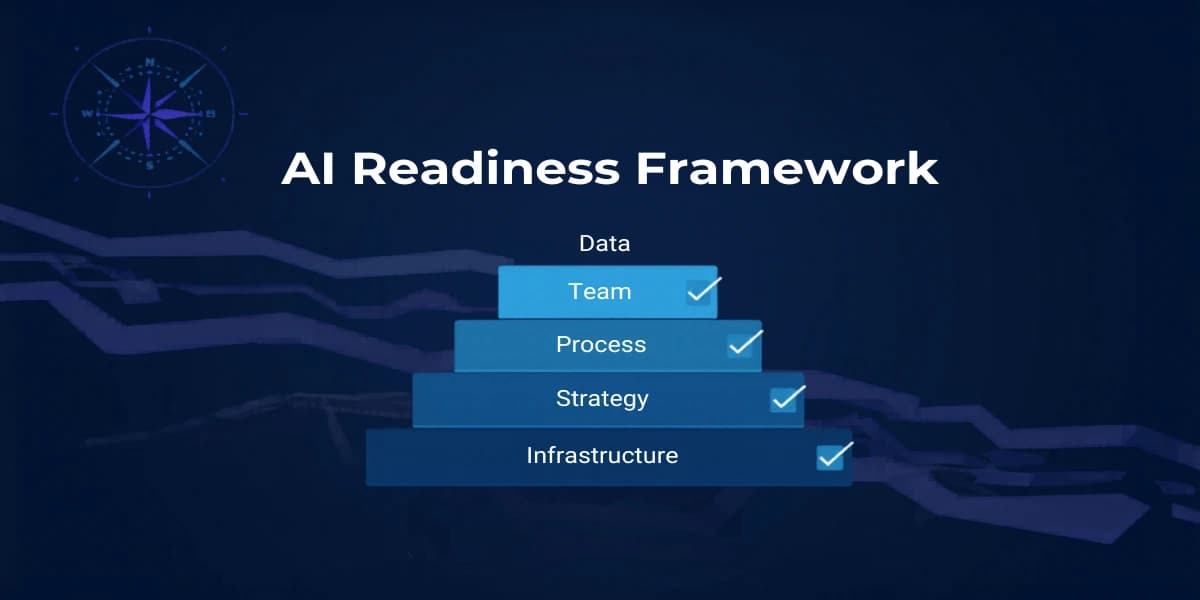
The biggest mistake organizations make with AI is spending months evaluating technology before they have assessed their own readiness to use it.
Technology evaluation is the last 20% of the decision. The first 80% is understanding your processes, your data, and your team's capacity to absorb change. Organizations that skip this end up with impressive demos that stall in production.
This framework gives you a practical way to assess where you are before you commit to anything.
The Four Dimensions of AI Readiness
Dimension 1: Process Clarity (0-25 points)
How well do you understand the processes you want to automate?
- Can you document the process from start to finish, including exceptions?
- Is the process consistent across the people who run it, or does everyone do it differently?
- Do you know the current error rate, cost, and time required?
- Are the decision criteria explicit (written down and agreed upon) or implicit (in people's heads)?
High readiness (20-25 points): Processes are documented, consistent, and measurable. You know exactly what success looks like.
Medium readiness (10-20 points): Some documentation exists. Key people understand the process, but there are informal exceptions and undocumented variations.
Low readiness (0-10 points): Process knowledge is tribal. Different people handle the same situation differently. No reliable metrics exist.
What to do at low readiness: Before adding AI, invest in process documentation. This is not a detour. It is the work.
Dimension 2: Data Quality (0-25 points)
AI works with data. The quality of your data determines the quality of your outcomes.
- Is the relevant data digital and accessible, or is it locked in paper, email threads, or unsearchable formats?
- Is the data consistent and structured, or is it freeform and variable?
- Is it complete? Are key fields regularly populated, or are there frequent gaps?
- Is it clean? Are there duplicates, errors, and outdated records?
High readiness (20-25 points): Data is digital, structured, consistently populated, and maintained.
Medium readiness (10-20 points): Data exists digitally but has quality issues. Significant cleaning and normalization may be needed.
Low readiness (0-10 points): Critical data is in unstructured formats, scattered across systems, or not captured consistently.
What to do at low readiness: A data quality project is a prerequisite, not a nice-to-have. AI trained on bad data produces bad outputs at scale.
Dimension 3: Organizational Capacity for Change (0-25 points)
The most overlooked dimension. AI implementation is a change management project as much as a technology project.
- Does leadership visibly support the initiative, or is it a departmental experiment?
- Is there an owner with authority to make decisions and enforce adoption?
- Does the team doing the work understand what AI will change about their jobs?
- Has the organization successfully adopted significant process changes in the past 24 months?
High readiness (20-25 points): Strong executive sponsorship, clear ownership, and a team that understands the change management component.
Medium readiness (10-20 points): Management support exists but is not consistent or active. Ownership is shared or unclear.
Low readiness (0-10 points): AI initiative is driven by a small team without organizational authority. Significant skepticism or resistance exists.
What to do at low readiness: Secure a formal executive sponsor and define ownership before starting. Lack of organizational support is the most common reason AI projects fail.
Dimension 4: Use Case Specificity (0-25 points)
Vague AI ambitions produce vague results.
- Can you define exactly what task or decision AI will handle?
- Can you define what "good output" looks like in measurable terms?
- Have you identified a specific team and process to start with?
- Can you articulate the business impact of improving this process?
High readiness (20-25 points): Clear, specific use case with defined success criteria and measurable business impact.
Medium readiness (10-20 points): General area identified but specific use case not yet defined.
Low readiness (0-10 points): "We want to use AI" without a specific application in mind.
What to do at low readiness: Run a structured opportunity mapping session before evaluating technology. Use case clarity is what separates good AI investments from expensive experiments.
Interpreting Your Score
80-100: High readiness. You can move quickly into implementation. Focus on sequencing and speed.
60-79: Ready with conditions. Address the 1-2 dimensions where you scored low before scaling. Start small in your highest-readiness area.
40-59: Foundational work needed. A 30-60 day preparation phase before implementation will dramatically improve outcomes.
Below 40: Invest in foundations first. A technology investment now is likely to underdeliver. The work is organizational, not technical.
Using This Framework
This assessment is most useful when done with honesty rather than optimism. Organizations that overestimate their readiness end up with failed pilots and organizational skepticism about AI that can set them back years.
The goal is not to score well. The goal is to know where you actually are, so you can make good decisions about where to invest.
If you want to run this assessment yourself, take the 10-minute version at getkoi.ai. It covers the same four dimensions and produces a scored readiness profile with specific recommendations.
If you want to run a facilitated version with your team -- typically two hours, produces a scored map and prioritized starting point -- book a 30-minute conversation to scope it. The assessment engagement runs $2,000-$5,000 depending on team size and vertical complexity.